

How To Make Money With My Wordpress Blog
My Money Blog has partnered with CardRatings and Credit-Land for selected credit cards and may receive a commission. I may be compensated if you click on a link and make a purchase. All opinions expressed are the author's alone.
Morningstar Safe Withdrawal Rate Report: 3.3% Base Rate + Ways To Increase It
 Financial freedom seekers usually have a Number – the value at which their investments can support their spending indefinitely. This is directly linked to "safe withdrawal rates". For example a 4% safe withdrawal rate is a 25x multiplier – meaning $30,000 in spending needs not covered by Social Security, annuities, or pensions would require 25 x $30,000 = $750,000. Morningstar recently released a 59-page research paper called The State of Retirement Income: Safe Withdrawal Rates (summary article) that digs deeper into the "4% rule". The headline is that they now estimate 3.3% a conservative base rate (30x multiplier):
What's a safe withdrawal rate for retirees? We estimate 3.3%. However, there are various factors that could affect this percentage, resulting in the retiree withdrawing a significantly higher amount. This report explores ways that retirees can make their savings last longer without compromising their standard of living.
Instead of focusing on the 3.3% base rate, look at the various ways you can improve it. The 3.3% base rate assumes a 50% stock/50% bond portfolio, fixed withdrawals (adjusted upwards for inflation annually, no matter what) over a 30-year time horizon, and a 90% probability of success. What if you changed up some of these assumptions?
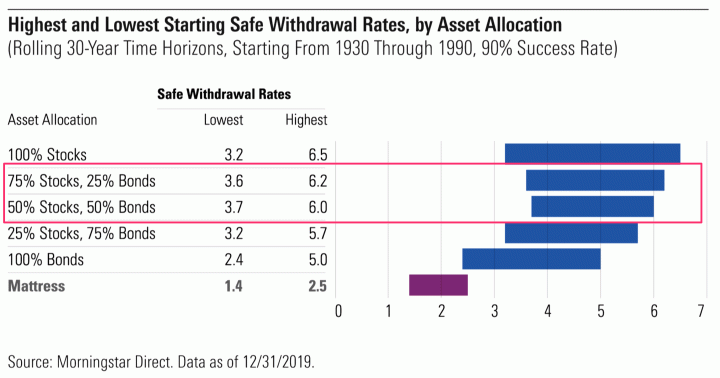
Lever #1: Hold a higher percentage of stocks. Historically, having a minimum amount of stocks is important in order to outpace inflation. However, going past 50% to 75% stocks no longer helps your minimum safe withdrawal rate. Not much room for improvement here.
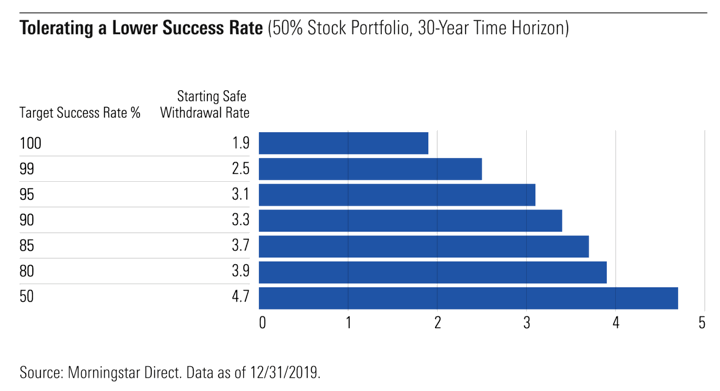
Lever #2: Tolerate lower safety (success rate). This chart is useful to help accept the role of luck for a stock-based retirement portfolio. The fact is that 50% of the time, you could have withdrawn 4.7% and been just fine. You simply don't know. (This is hard for me as a planner.) The retiree "Class of 2011" could have spent more than that so far without even denting their nest egg. However, the "Class of 2021" may have a very different experience. Going down to 80% probability of success moves you up from 3.3% to 3.9%.
Lever #3: Don't keep adjusting upward for inflation. Your personal inflation rate might not keep up with the national averages. You might very well spend less as you age. If you adjust for 3/4th of inflation, that 3.3% goes up to 3.6%.
Forgoing inflation adjustments–at least in part–is another lever. That might seem farfetched in the current environment, given that inflation is top of mind. But research from David Blanchett, formerly of Morningstar but now at PGIM, has demonstrated that retirement spending doesn't necessarily track inflation and often trends down throughout the lifecycle. Our research shows that the retiree who adjusts his or her paycheck by just 75% of the actual inflation rate would be able to take a starting withdrawal of 3.6%, for example.
Lever #4: Work longer. Make more money, make retirement period shorter. Not much fun, but effective. My view is that any amount of income will help reduce your withdrawal rate, if you have the time and ability. It is less common nowadays to go from full-time job to zero income. Working 10 hours a week feels much different than 40-50 hours a week.
Reducing the time horizon for drawdown–for example, by delaying retirement a few years–can likewise contribute to a higher starting safe withdrawal rate. For example, delaying retirement by five years and truncating the in-retirement spending horizon to 25 years from 30 results in a starting safe withdrawal amount of 4.1%.
Lever #5: Flexible spending based on market performance. There are several ways that you could adjust your spending in retirement in response to your portfolio's return. In general, you'd want to spend less when the market is down. Some of this will come naturally as it's easier to cut back on spending when you see your friends and neighbors cutting back as well. However, I was surprised to see that several of the proposed methods really don't change the numbers much.
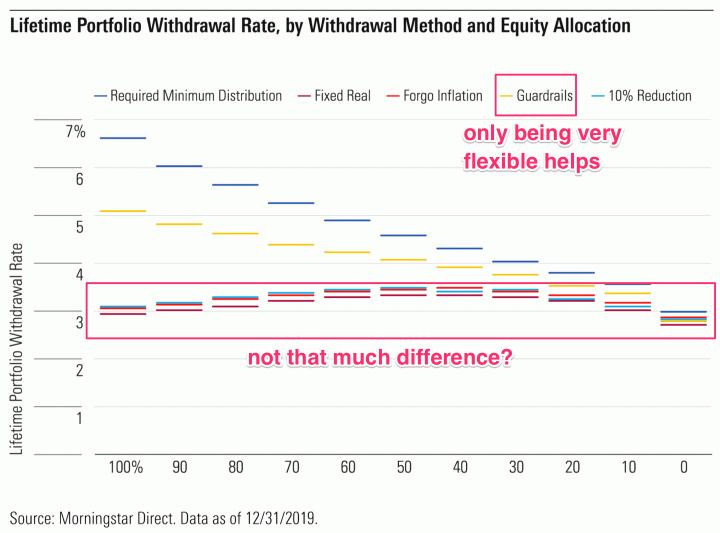
The method that does help significantly is called the Guyton-Klinger "guardrails" method, which allows inflation adjustments but applies "guardrails" so that the spending rate stays within 20% of the initial withdrawal percentage. Lets say your initial percentage is 4%. If markets go sky-high, the guardrails let you spend at least 3.2% of your new portfolio value (with inflation adjustments). If markets plummet, the guardrails let you spend at most 4.8% of your new portfolio value (with inflation adjustments).
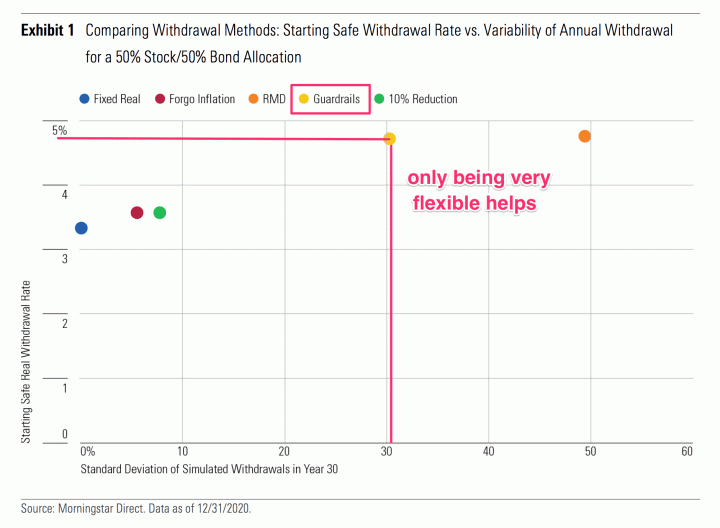
Hold up! Early Retirement Now has an excellent post about how the Guyton-Klinger guardrails are much more "variable" than just +/- 20%. The guardrails move with the portfolio value. If you started out taking $40,000 out of a $100,000 portfolio, by following this rule starting in 1966, your income would have dropped to below $20,000 a year! A 50% drop in income is far too flexible for most people.
My personal thoughts. Every year that passes, I pay less attention to historical backtests and precise safe withdrawal rates. Instead, I care more about understanding the earning power of the assets that I own (including my own skills), and understanding the structure and flexibility of my expenses.
In regards to market returns, it is better to be lucky than anything else. Let's say you retired about a year ago on October 31st, 2020 and owned the Vanguard Balanced Index Fund (VBIAX) that is 60% US stocks and 40% US bonds. If you had a $1,000,000, a 4% withdrawal rate is $40,000. But a year later, on October 31st, 2021, your portfolio would be just shy of $1,200,000 ($1,195,584) even after taking out $40,000 during the first year. This is just after one year!
In other words, 3.3% could easily be obsolete in a year. You are multiplying a safe withdrawal rate by something that can easily move up or down 20% each year, so why care about decimal points? Focus on what you can control. Looking back at all the levers above, here is what I can control:
- Accept that a stock-based retirement portfolio will rely on luck. 3% = very safe. 4% = probably safe. 5% = risky. 6% = not safe.
- Keep your portfolio in retirement somewhere between 50% and 75% stocks, with the rest in investment-grade bonds.
- Don't blindly keep taking out more money each year for inflation.
- Working longer may be required, but explore ways to downshift while still making some income. Even small amounts of income make a difference. For example, 1% of $750,000 is $7,500 per year ($144/week). Earning $144 per week in income would move you from a 5% withdrawal rate to a 4% withdrawal rate, from a 4% withdrawal rate to a 3% withdrawal rate, and so on.
- Don't plan to spend the same amount every year. Spend less when markets are down, as most people do anyway. Think about the flex in your budget. Don't lock in long-term commitments (vacation home ownership, any debt, agreements to pay for your kid's X). Pick things that you can shut off (vacation rentals, travel, dining out).
Last updated: November 30, 2021
Giving Tuesday 2021: Matching Donations and Finding The Right Charity
November 29, 2021 By Jonathan Ping
 Tuesday, November 30th is Giving Tuesday 2021, an international day about giving support through charities and nonprofits by donating money or volunteering your time. In case you aren't inundated with mailings already, this time of year is a big deal for charities, with 40% of donations occurring in the last six weeks of the year. Here are some ways you can "double your impact" with a matching donation.
Facebook Match (good toward any charity that accepts donations via Facebook). Starting at 8am Eastern on 11/30, Facebook will match $8 million in donations to U.S. nonprofits – up to $100,000 per nonprofit and $20,000 per donor. Donations will be matched for the first $2M, 10% for the next $6M.
For example, give directly with the donate button on the The Humane Society Facebook Page. You can also start your own fundraiser here or simply post up a donate button to support your favorite charity.
Double Up Drive. Check out the high-quality, spotlighted charities at Double Up Drive where your donation up to $10,000 can be matched dollar-for-dollar:
At Double Up Drive, we believe that public giving influences greater generosity and that resulting donations carry more impact. We raise money and awareness for highly effective charities by hosting matching drives that collect up-front pledges from large donors, to provide 1:1 matches for smaller contributors.
Check for an employer match. Try this lookup tool from DoubleTheDonation. Most of these programs don't require you to actually give on a specific day, but you may want to start the process today so you don't forget in the holiday rush.
Individual charities. Many charities are organizing their own matching program for #GivingTuesday. Here are some large charities have organized their own matches in the past, but I would check to make sure.
- American Red Cross
- UNICEF USA
- Feeding America
Also check with your favorite local community nonprofit. GivingTuesday.org has some additional ideas.
Having trouble deciding where to give? Here are some charity comparison sites that will help you pick where to send your help.
- CharityNavigator – Largest and well-publicized charity rating site, provides a 4-star rating based primarily on financial criteria.
- GiveWell – Tries to identify the best charities, not rate them all. Focused primarily on charities working internationally that "save or improve lives the most per dollar". Examples are treating malaria and parasitic infections in developing countries.
- GreatNonProfits – Allows clients, volunteers, and funders to post personal reviews based on their experiences. Lots of reviews of smaller, local charities.
- GuideStar – Tries to be a one-stop shop for both financial data and in-depth analysis of charities. Must register (free) to see a lot of things, and pay a subscription fee for premium data (aimed at industry insiders).
Looking to volunteer your time? Check out Feeding America and VolunteerMatch to find a volunteer opportunity near you.
Last updated: November 30, 2021
IKEA Gift Cards: Buy $100 in Gift Cards, Get Free $20 eGift Card (11/29 Only)
November 29, 2021 By Jonathan Ping
New Cyber Monday offer - One day only. IKEA has a limited-time promotion where for every $100 gift card that you buy online, you will receive a bonus $20 eGift Card. Terms and conditions: For every $100 in IKEA eGift cards purchased online from … [Read the rest]
Last updated: November 29, 2021
Black Cyber Deals: Low-Hanging Fruit and Buy Now Pay Later Mind Tricks
November 28, 2021 By Jonathan Ping
I attempted a bit of a "digital vacation" this long weekend in order to maximize my feelings of thankfulness, but I couldn't help taking a peek at what was available in the "I was going to spend this money anyway" department. I'll try to keep this … [Read the rest]
Last updated: November 30, 2021
Healthywage Review: Bet on Yourself, Get Paid To Lose Weight ($100 Prize Bonus)
November 25, 2021 By Jonathan Ping

(Black Friday Promo: Click this special link for $100 Healthywage Profit Boost for a limited-time until December 3rd, 2021. This is the highest promo they offer, and only a few times per year. Look for the banner on top. Read on for how Healthwage … [Read the rest]
Last updated: November 25, 2021
Discount Magazines Black Friday Sale 2021
November 25, 2021 By Jonathan Ping

The annual DiscountMags.com Black Friday Sale is one of the few times where they post their lowest prices for the year. This is time of year that I either order some gifts or just lock-in cheap pricing for multiple years. Many issues cost barely … [Read the rest]
Last updated: November 25, 2021
AMC+ Black Friday Deal: $1.99/Mo with Annual Plan (70% Off)
November 25, 2021 By Jonathan Ping
The AMC+ streaming service is also running a Black Friday deal where you can pay $1.99/month if you buy the annual plan ($23.88 + tax). The standard monthly cost of AMC+ is $8.99 (plus tax). The standard price for the annual plan is $83.88, making … [Read the rest]
Last updated: November 25, 2021
Chewy.com Black Friday: Free $30 Gift Card with First $49 Rx
November 23, 2021 By Jonathan Ping

Online pet store Chewy.com is offering a variety of Black Friday deals. I'd like to see another 15% off gift card deal, but this one also looks good: Free $30 Chewy eGift Card with First-Time Pharmacy Purchase of $49+. Buy your flea … [Read the rest]
Last updated: November 23, 2021
Hulu: $0.99/mo for 12 Months (with Ads)
November 23, 2021 By Jonathan Ping

Hulu has a Black Friday deal where new and returning subscribers can get the ad-supported plan for 99 cents a month for 12 months. Will auto-renew after 12 months at regular price, so set a calendar reminder to cancel. Offer expires November 29th, … [Read the rest]
Last updated: November 23, 2021
Time Best Inventions of 2021: Easy 401k Rollovers, Optimize Home Remodels, AI Tutor, Kid Plane Bed
November 23, 2021 By Jonathan Ping

Time magazine has announced their Best Inventions of 2021. In addition to offering a hopeful look at the future each year (which we can all use these days), I always find a few useful products and services that can save you money and/or effort as … [Read the rest]
Last updated: November 23, 2021
Buy $100 Apple Gift Card, Get $15 Target Gift Card Free
November 21, 2021 By Jonathan Ping

Get a free $15 Target GiftCard with $100 Apple gift card purchase. A simple Black November deal if you already buy Apple products/services and shop at Target. While supplies last. Offer available online (e-mail delivery only) and in-store. … [Read the rest]
Last updated: November 25, 2021
Dimensional Fund Advisors (DFA) ETF Lineup Keeps Expanding
November 18, 2021 By Jonathan Ping

Some investors like to break down their portfolio into several different asset and sub-asset classes. One long-standing example of the "slice-and-dice" is the "Ultimate Buy-and-Hold Portfolio" recommended by Paul Merriman (see pie chart; expanded … [Read the rest]
Last updated: November 18, 2021
How To Make Money With My Wordpress Blog
Source: https://www.mymoneyblog.com/
Posted by: joneshicip1993.blogspot.com
0 Response to "How To Make Money With My Wordpress Blog"
Post a Comment